Hazards of a Ticking Clock - Blood of the Dawnwalker

Upon release there was a lot of buzz about the use of time in ‘Blood of the Dawnwalker’, but how does the pressure it creates influence player decision-making?
I've been much busier in the last few weeks than I anticipated, which has left me less time for side projects and blogging. However, I wanted to talk a little about time in Blood of the Dawnwalker while it is fresh in my mind.
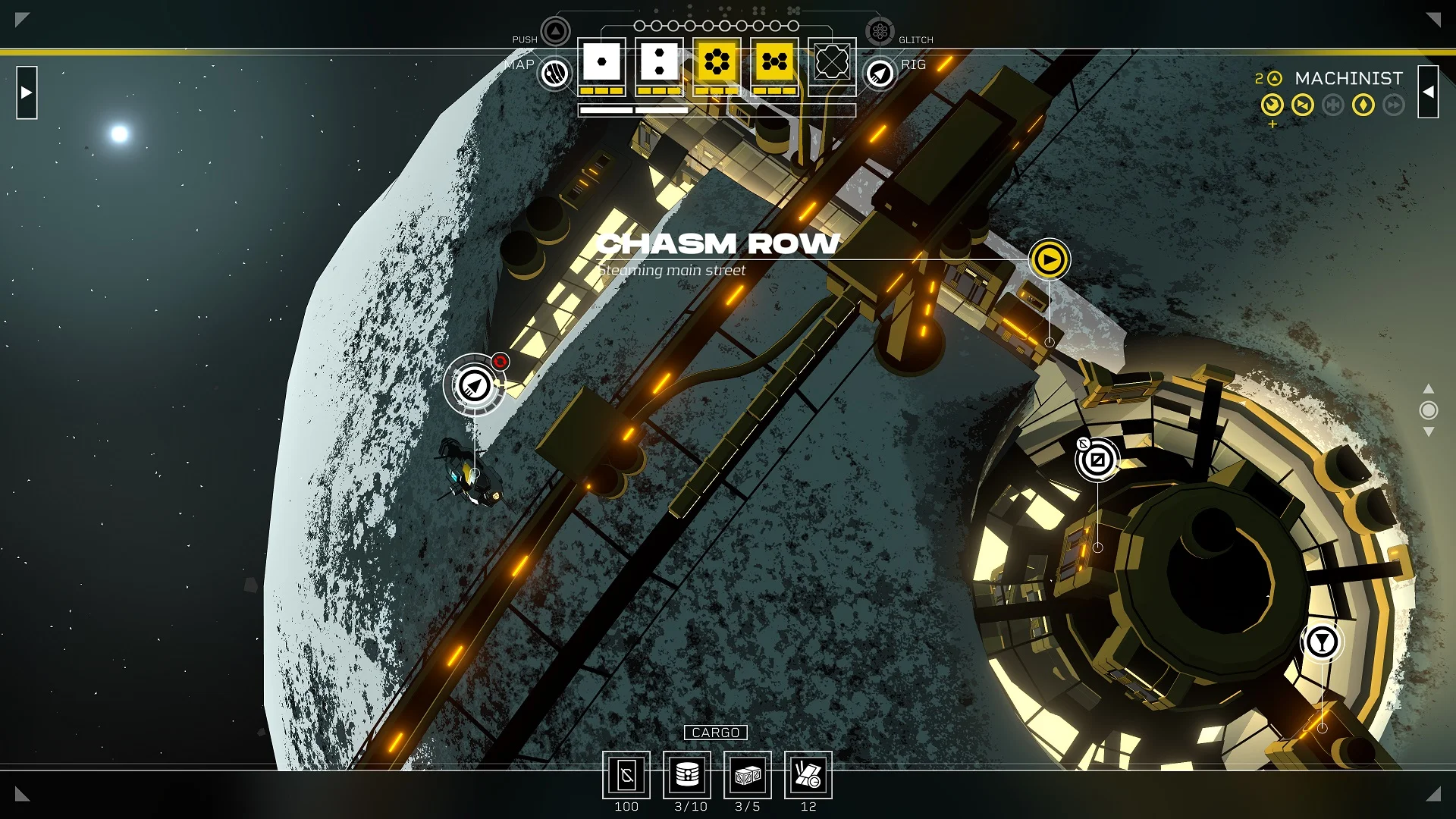
For those unfamiliar, in Blood of the Dawnwalker there is always a clock at the top-right of the screen. This clock does not tick all the time, instead it ticks forward after certain actions, such as engaging with quests. As a mechanic it feels very inspired by tabletop roleplaying games or board games. In the digital realm the first comparison that popped to mind was the Citizen Sleeper series, which uses ticking clocks (reminiscent to those in Blades in the Dark) as its primary source of tension.
Conceptually, I love it. Not only does it feel like a fresh and interesting mechanic to bring to the AAA space, which I think the Blood of the Dawnwalker team should be applauded for, but I'm also just personally fond of interesting time mechanics. I've had an idea for a calendar/time/rest TTRPG supplement bubbling around in Google docs for a few months now, so I might be a bit biased.
All that being said, I think there's a lot to be learned about when Blood of the Dawnwalker's clock is most effective, and what the shortcomings of the system are in practice.
Disclaimer: I have yet to finish Blood of the Dawnwalker, but I do currently have the option to complete it if I wanted to. While I have heard how you engage with time can change interactions at the end of the game, I believe I have played enough of the game to dissect the mechanic a good bit.
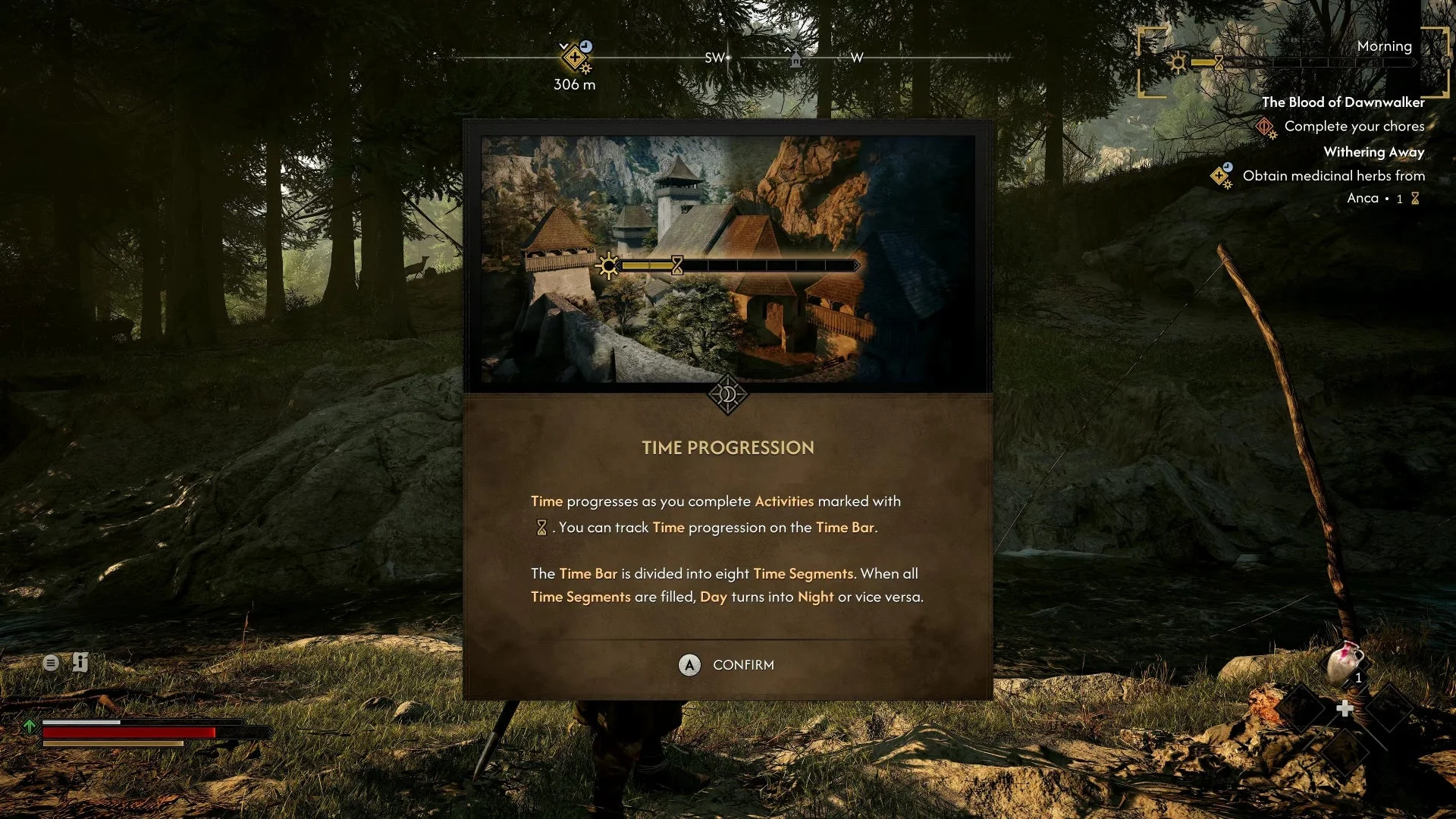
The tutorial section of the game introduces the player to the system and overall I think it does so beautifully. You are released into your starting village with an immediate tutorial about time, explaining that it will progress when the player takes important actions, such as completing or pursuing quests. There are four elements to the section that are key to its effectiveness:
- The time the player has before them is short. There are only 8 "segments" of time before the end of the tutorial event, which is the equivalent of one day.
- As the player moves through the village to pursue their primary quest they are confronted with lots of other quests they could pursue. In fact, it immediately becomes clear it is too many quests to be able to do all of them.
- The side quests presented to the player have a wide variance of urgency or importance. Some seem to just be chances to build relationships with NPCs, while others have high stakes, with one or two seeming to have life or death consequences.
- The primary quest the player has has a very clearly implied time pressure in addition to the 8 segments they have for the day, meaning the sooner they complete it the more likely they are to have a good outcome.
Overall, this creates an incredibly compelling decision space, where the player feels like they are making compelling narrative decisions via whether or not they engage with content. Do they let themselves get distracted, or focus on their primary quest? Should they ignore the quests that seem to have less urgency, or will building those relationships be important later on? Will the quests that seem more involved take too long, or are they important enough to take the hit?
From what I could tell some of these choices are imagined—meaning that the consequences the player imagines affects their experience, while the game would not have punished them in reality. Many of the relationship building quests seem to be fully inconsequential, but that is invisible to a first time player.
When playing I was thrilled by all of this, it felt like some secret sauce I hadn't seen in an RPG of this size before. However, when I was released into the open world after the tutorial section, how I related to the time system changed drastically.
The Wide, Open World
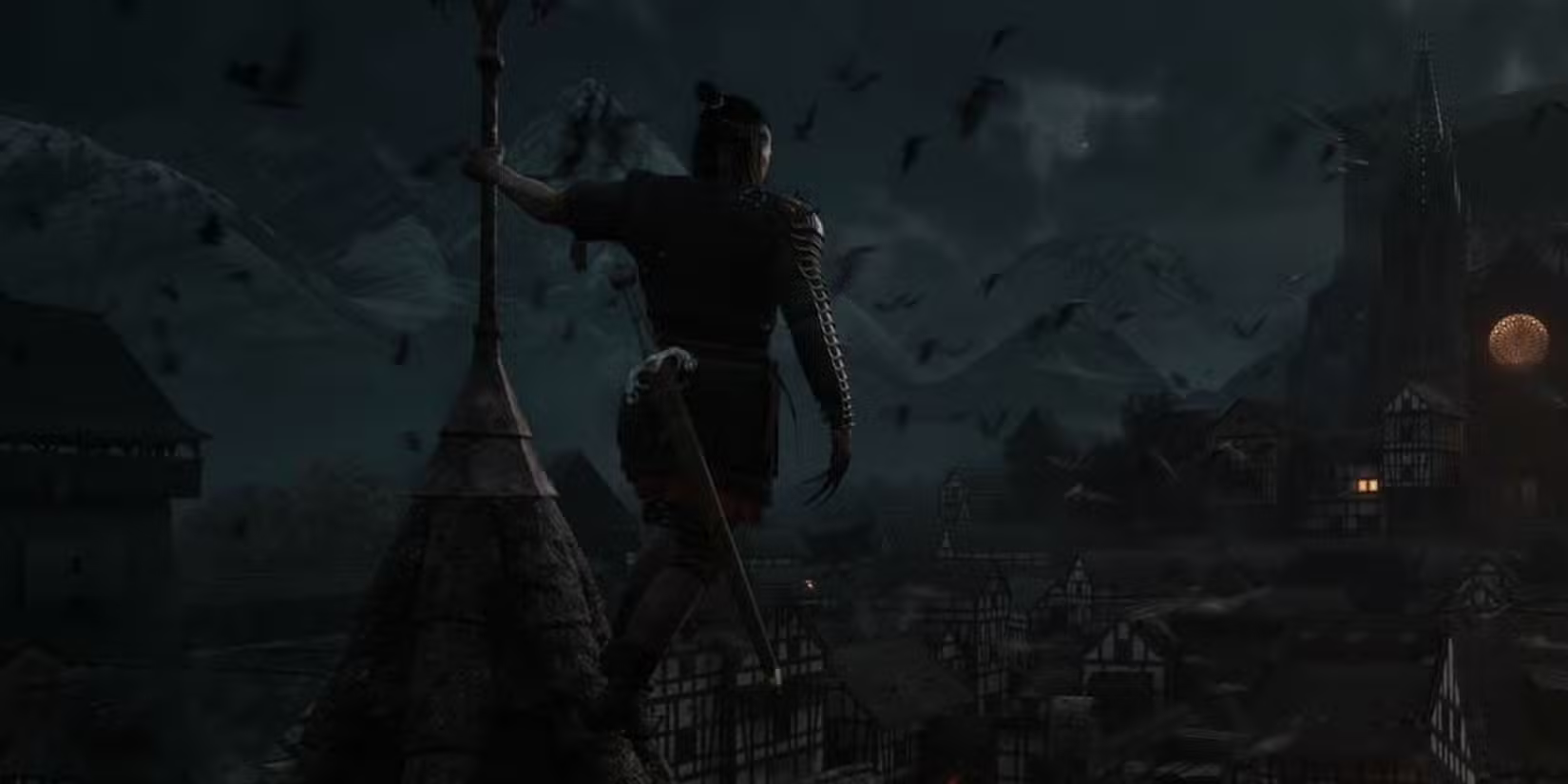
After the tutorial you are given the final objective of the game. Your time limit? 30 days. That includes both days and nights, which gives you a total of 480 time segments for all content you wish to complete before triggering the finale (which you don't have the ability to do just yet).
Side Note: I love when an RPG gives you a seemingly impossible objective and just says "hey you take it from here, figure it out". Blood of the Dawnwalker in particular doesn't hold your hand in a way that I appreciate, but that's not what I wish to dissect.
This is a huge change from the tutorial where spending time was far more concrete. If you were to spend 1 time segment in the tutorial that was 1/8th of your time budget, or 12.5%. In the full game a single time segment is 1/480 of your time budget or 0.21%. What was concrete becomes abstract and difficult to comprehend. Our brains are not great at intuiting math of that scale.
Not only does your time budget expand, but how you spend time changes as well. In addition to completing traditional quests, the following will also move time forward:
- Upgrading your character. After you level you get talent points, but you must pass time to spend them.
- Open world quests tied to the "Court" system. To trigger the quests of vampire bosses, you need to sufficiently anger them by completing open world quests related to them.
- Open world content of little consequence. These are open world activities that would be familiar to anyone who has played an open-world game. In particular, I am thinking of the "save a random passerby who is under attack" activities.
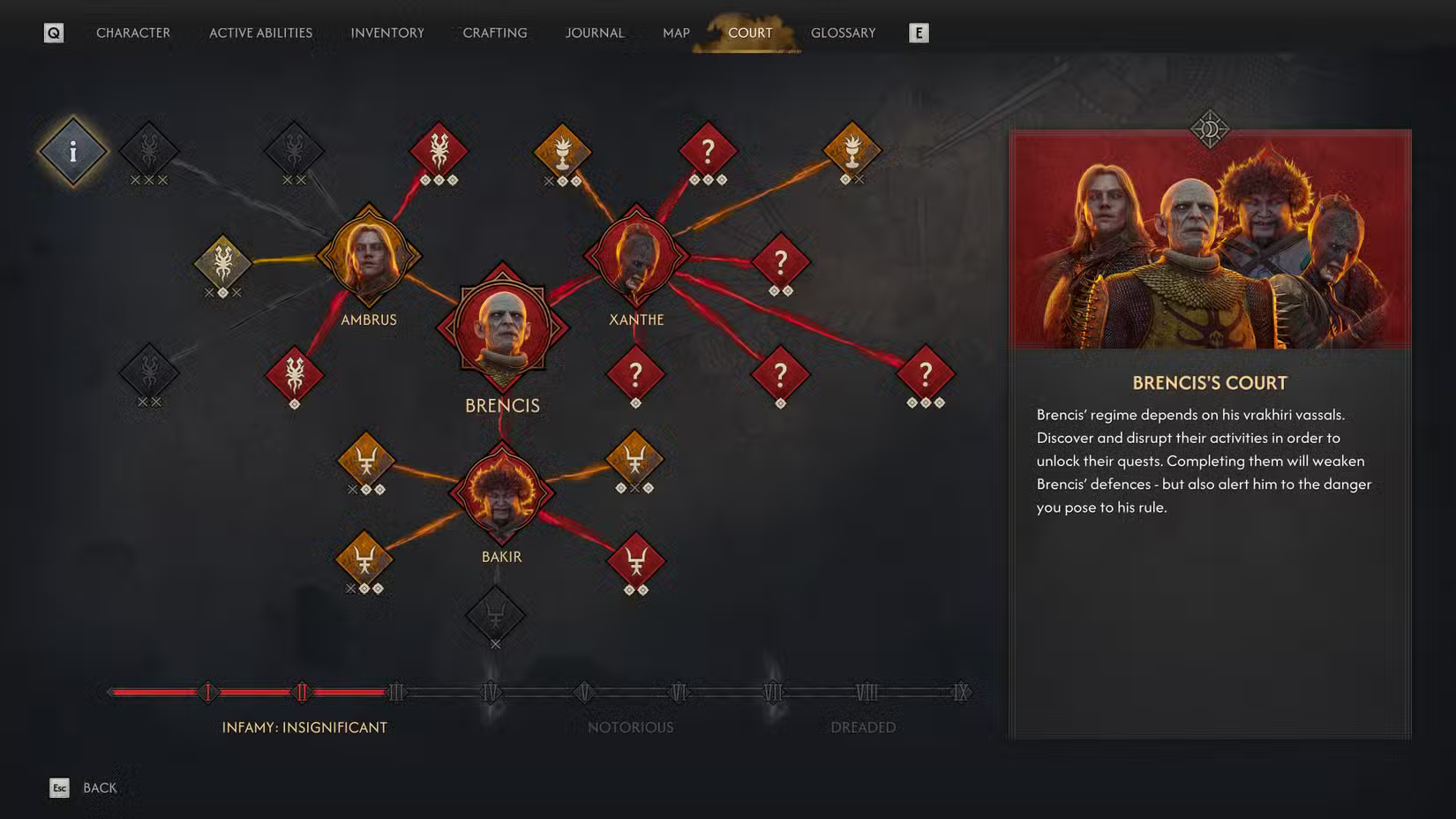
Altogether this encourages two playstyles, both of which lose that secret sauce that the time system brought to the tutorial.
Playstyle #1 - Don't Think About It
With the scale of time before them becoming difficult to comprehend, some players will likely take to ignoring the system altogether. Engaging with the world and the game holistically, they will engage with whatever they find most compelling in the moment without considering the time cost very much.
Where it will most come into play is when it shifts from day to night and the player changes from human to vampire, or likely when they are running out of time near the end and it is impossible to ignore.
This playstyle is not really destructive, and I think this is likely how the average gamer will engage with the system. I suspect this is also how the game designers anticipated most players to interact with it in their first playthrough. It isn't a bad way to play the game at all, it adds a layer onto an open-world RPG that encourages multiple playthroughs: not being able to even attempt all the content in the game. That, in and of itself, is interesting!
However, I do think it means the player doesn't get that really compelling experience that is hinted at in the tutorial, where they are regularly making interesting and informed choices based on how much time they have to accomplish things.
Playstyle #2 - Avoid Engaging with the Game
The more problematic playstyle is players who become overly cautious with the system. For them the tutorial so effectively sets up the stakes of the time system that, even when time becomes more abstract, there will always be a question in the back of their minds: is this important enough to spend my limited time on?
If all content which spent time were as impactful* as it was in the tutorial, this train of thought would not be problematic; in fact it's a question that a system like this prompts you to ask. But the value of the content in the primary game varies wildly, from main story quests to open world activities; and while the time has become abstract, the stakes can feel high. A knowledgeable player knows this game is an RPG and that it is normal for RPGs to have various endings. They know there is the potential to get a bad ending, and with the clock ticking they are now thinking about how they might “lose”.
*To define that a bit, by impactful I mean impactful on the world in some tangible way: influencing relationships with characters, impacting major moments in the game, changing encounters, unlocking exciting content, etc. Even the quests that clearly had no consequence in the tutorial were chunky bits of content with back and forth conversations and memorable moments with interesting characters.
The most obvious issue here is the open world activities, which seem to have little to no impact at all outside of gaining gold or low rarity items, which are fairly easy to come by. Involved characters seem to be throwaways, and are often unnamed. If a player is being efficient and aiming to try to get the best ending they can, ignoring people screaming for aid on the side of the road becomes an easy choice. This isn't a huge problem, but does create an interesting player behavior.
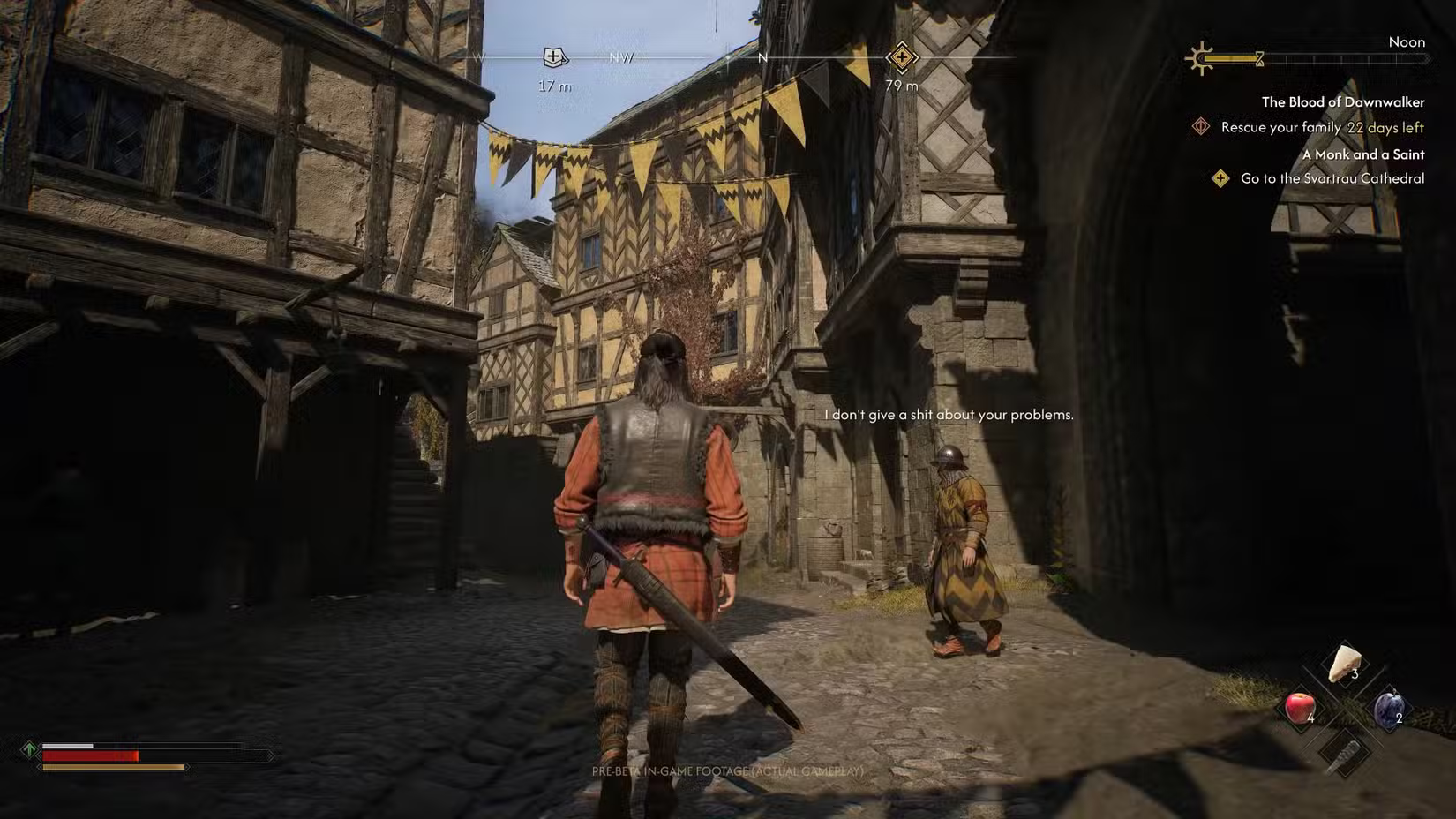
These issues can even extend into the Court quests, though less so. The game does a good job of pointing in the direction of the Court system, with an easy to find questline telling you that you need to (spoilers ahead) complete enough Court system quests to earn the trust and cooperation of a faction who can help you complete your final objective. However, the Court system quests on their own rarely have significant impact and often are large time sinks, taking up multiple time segments per quest. The game also implies to the player that recruiting the faction is not explicitly necessary and, from what little spoilers I have about the ending, I know that is technically true. The Court system screen also clearly states that completing these quests will not only earn the ire of your enemies, but will also make you known to them. If a player is stealth minded, anticipates there being multiple endings, and also wants the best shot to get a good one, they now have multiple reasons to avoid the Court quests. It saves them significant time, they get to skip quests that seem minimally impactful, and they get to stay off the radar.
The worst conflict between time and gameplay however, is how the player thinks about upgrading their character. At the end of the day, upgrading your character is an optional player action. As long as you are able to complete content, you don't need to upgrade your character, and if you care about being as careful with your time as possible... you might hold off for a long time. The player's desire for the best narrative outcome is now in conflict with engaging with player progression. If a player plays this way the game will become more frustrating to play, enemy encounters will become unbalanced, as the game expects them to be powering up along with your level.
You have probably guessed, but I have been an "Avoid" player. I completely ignored all open world activities, I am frequently sitting a ton of talent points, and I ignored engaging with the Court quests until something 14 days into the 30 days of the timer. The longer I played, the more clear it became to me that the game wasn't really designed for me to make decisions this way. I got an option to end the game after completing a pretty involved questline on day 9 or 10. At that point, it didn't feel like there was much content left for me. Outside of the Court quests, things were feeling pretty empty. Looking out over the valley, I felt like I had played the game wrong, skipping a lot of content that was intended for most players to have experienced.
For me, that's when the tension fell out of the game. I suspect I held onto that feeling longer than most, but it was gone. At that point I started spending my points more freely and decided to start pursuing the Court quests.
What can we learn from Dawnwalker's time system?
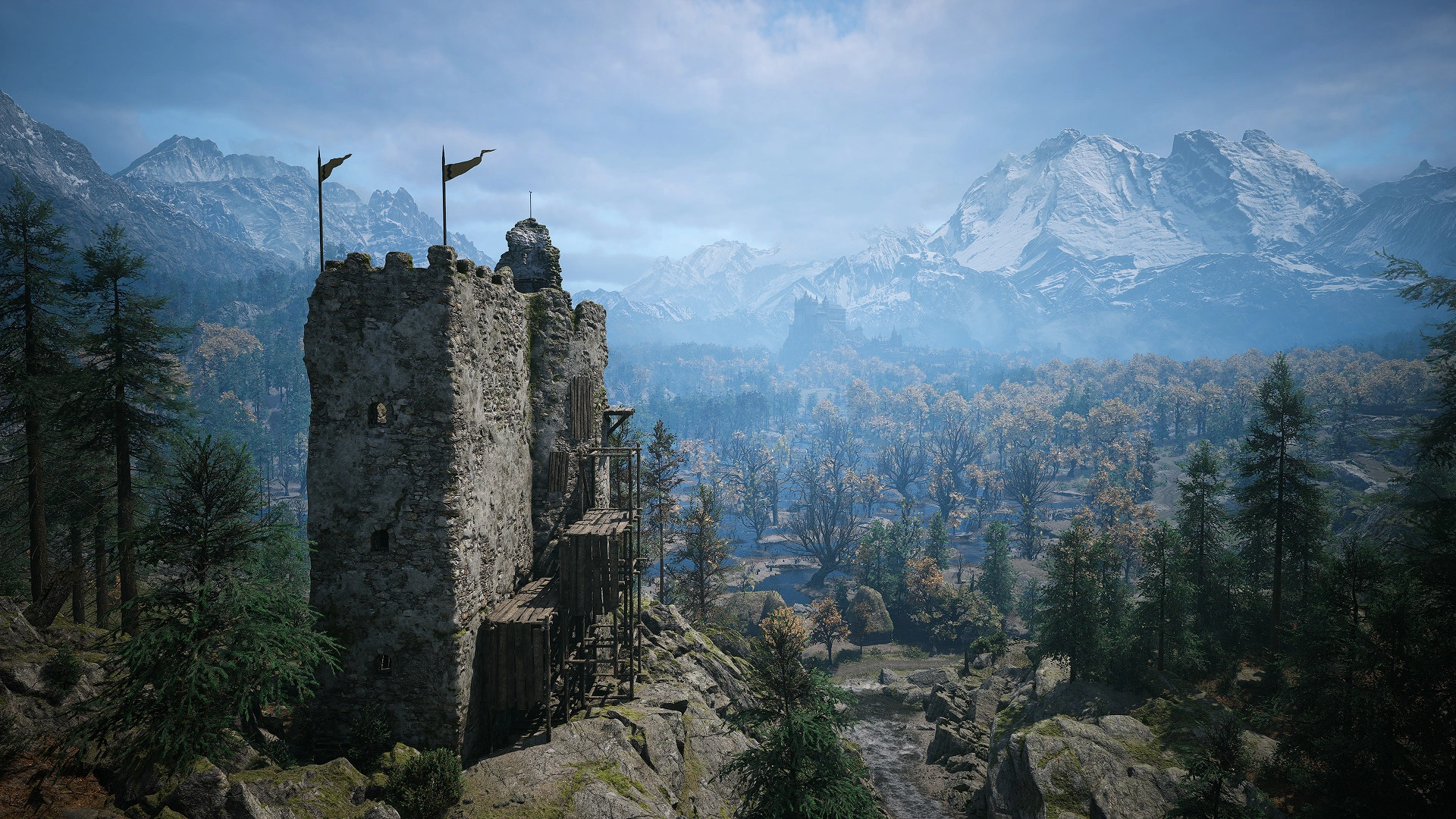
I think what we take away from Dawnwalker's time system depends on what you want the time system to accomplish. Thus far I have written with an assumption, which is: what we want out of the system is to generate that secret sauce, that feeling of making informed and interesting decisions, simply based on what you choose to engage with.
However, that may have not been the primary design intent of this system or how someone would want to adapt this for another game. So when thinking about what we can learn, let's think about how we can modify Blood of the Dawnwalker to best accommodate the two styles of play we have discussed:
#1 - A playstyle where the time limit is "background noise". It limits how much you can do in a single playthrough, but it isn't at the front of your mind.
#2 - A playstyle where players feel like they are regularly making informed and interesting decisions based on where they chose to spend their time.
To adjust the game that facilitates #1, I think you'd want to introduce the timer after the tutorial. If the time system is never meant to be a major focus of the player experience, it should not be introduced in a way where choices are so time limited and impactful. There could be sections of it later as a fun mix-up that says, "Hey look at what we can do with this system, isn't that cool?", like Bakir's quest, but it isn't setting a precedent. I'd also suggest removing the time sink for character progression, as even for this playstyle I think it's too likely to encourage avoidant player behavior.
Adjusting the game to support #2 is significantly harder, but a few changes that might accomplish it are:
- Remove time cost for open world activities, restricting it only to "high-value" moments, such as quests with meaningful character interactions.
- Remove the time cost of upgrading your character.
- Create another time sink which is more explicitly necessary to make the player pass time. As a central part of the game is moving between night and day you cannot allow the player to completely avoid it. A few ideas:
- Break the map up into regions, discovering a new region moves time forward one tick.
- A sleeping mechanic where the player gains a debuff if they have not rested in a certain amount of time, and sleeping allows you to spend any attribute points you have. That extra stick with the carrot reduces the likelihood players will avoid progression, while also simplifying the decision.
- Reduce the number of days the player has to complete their final objective.
Ultimately I think the best way to create a game which fosters #2 is really to feature the mechanic in a game that is not so open ended, which makes it a bit difficult to fit onto the overall structure of Blood of the Dawnwalker. It seems to me this time mechanic is always going to work better when the time limit is smaller, when you can easily intuit how valuable spending a time segment is.
So if you're reading this and you're working on a non-open world RPG, please steal this mechanic! It's gold, and I want to see it in more games!
Final Thoughts
As a final thought, I just want to say I've really enjoyed Blood of the Dawnwalker, and even though I don't think the time mechanic really sticks the landing, I think it's extremely interesting and I love that a game of this size took a swing at it. I was extremely pleased to hear the studio is planning to make more of these, as I will happily play many more of these vampire games.
Thanks for reading! I’d love to hear your thoughts on this system, or if there are other games with time systems like this I should check out!